

Bishop Barron Picked a Side
When ideological language replaces pastoral voice

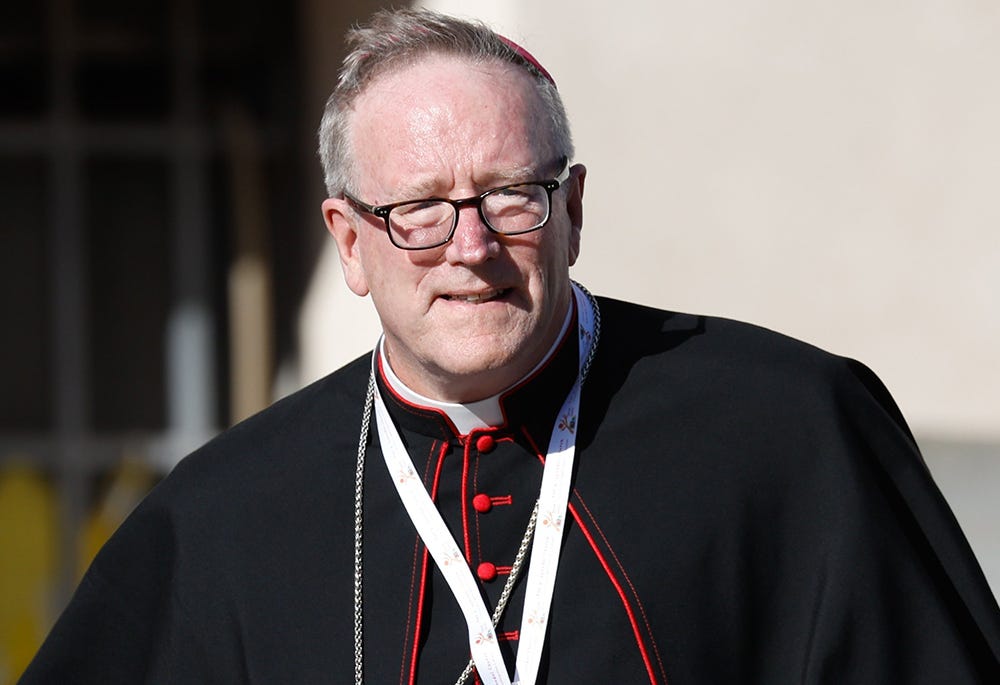
Bishop Robert Barron chose to speak in the language of ideology at a moment when much of the Catholic Church was speaking in the language of dignity.
Immigration enforcement actions in Minnesota left two U.S. citizens dead. Tensions rose quickly. Catholic leaders across the country responded with familiar words: restraint, prayer, the sanctity of human life. The U.S. bishops emphasized human dignity in public statements. Rome continued its steady insistence that migrants are persons, not abstractions.
Barron framed it differently.
In widely reported remarks responding to Rep. Alexandria Ocasio-Cortez, Barron described her critique of Western civilization as “unapologetically Marxist” and said it reflected ideas “right out of the Marxist playbook.” He invoked Marx’s hostility toward religion and cast the dispute in explicitly ideological terms. The comments were reported by The Christian Post. In his telling, the fight was ideological, full stop.
He also rebuked protesters clashing with immigration authorities and emphasized enforcement priorities and the removal of serious criminals. None of that falls outside Catholic teaching. The Church recognizes the authority of the state. That has never really been the question.
The real issue here is tone.
Invoking partisan labels in the middle of a volatile moment is a deliberate choice. It places a bishop inside a political frame, whether he intends that or not.
That choice carries weight. Barron is not simply the bishop of a small Midwestern diocese. Through Word on Fire, the apostolate he founded, he reaches millions through books, films, study programs, subscription content, and fundraising campaigns. Word on Fire functions at the scale of a modern media brand.
It has not been free of controversy. Catholic reporting documented staff resignations and internal morale concerns in recent years, along with disputes over leadership culture, as reported by National Catholic Reporter. NCR also published an annotated review of a video Barron posted after attending President Trump’s 2025 joint address to Congress, highlighting his description of the event as a “high liturgy of our democracy” and his detailed recounting of insider access and partisan applause. Critics argued that the language and framing blurred lines between civic ceremony and pastoral voice. Online commentary has additionally argued that Barron’s recent rhetoric reflects a sharper political turn. Those episodes fueled debate about governance and what happens when evangelization meets branding.
Barron currently serves as a Trump appointee on a Religious Liberty Commission and has publicly praised President Donald Trump and Secretary of State Marco Rubio. Trump has praised him in return. When a bishop with visible ties to contemporary conservative figures uses campaign-style language, people notice. They always do.
In 2022, Pope Francis moved Barron from his role as auxiliary bishop in Los Angeles to lead the Diocese of Winona–Rochester, as reported by the National Catholic Register. Canon law treats that as a promotion. Optics are another matter entirely. His platform did not shrink. His audience did not narrow.
And that audience is listening now.
Catholic social teaching holds together border enforcement and human dignity. No one expects bishops to whisper. But in a moment marked by death and division, a bishop chose the vocabulary of ideological combat over the language many Catholics were hearing from Rome and from their own conference of bishops.
When bishops speak like partisans, they should not be surprised when the faithful begin to hear them that way.
Sources